If you’re new to amateur radio (also known as ham radio), listening to your first conversations on the air can feel like listening to an entirely different language.
What does CQ mean? Why do ham radio operators say 73? What is a QSO? And what’s the difference between SSB, FM and FT8?
Amateur radio operators use a variety of abbreviations, Q-codes, slang and technical expressions to communicate with one another. While these might seem confusing at first, you’ll soon find yourself using them without even thinking about it.
This ham radio glossary explains the most common amateur radio terms in plain English, so you can spend less time wondering what people are saying and more time enjoying the hobby.
New to Ham Radio? Start Here!
Knowing what all these terms mean is one thing, but knowing how to actually use them on the air is another.
Perhaps you’ve recently received your amateur radio licence but aren’t sure what to say on the microphone, which frequencies to use, how to make your first contact or why nobody seems to be answering your calls.
That’s exactly why I created Ham Radio in 30 Days: Zero to Hero.
My step-by-step beginner course helps you put your knowledge into practice, build your confidence on the air, understand how radio propagation works and start making contacts without constantly second-guessing yourself.
You don’t have to figure everything out on your own.
Find out more about Ham Radio in 30 Days: Zero to Hero
Common Ham Radio Terms and Abbreviations
These are some of the most frequently used words and expressions you’ll hear when listening to amateur radio operators.
Band – A range of radio frequencies. Amateur radio operators often refer to bands by their approximate wavelength, such as 20 metres, 40 metres or 2 metres.
Break – An expression sometimes used to request an opportunity to join or interrupt an existing conversation.
Callsign (Call Sign) – A unique identifier assigned to an amateur radio operator or station. Examples include VK7HH, K1ABC and G4ABC.
Calling Frequency – A frequency commonly used to establish initial contact with other stations before potentially moving elsewhere.
CQ DX – A call specifically looking for distant stations, often from other countries or continents.
DX – Long-distance radio communication. Making contact with a station on the other side of the world is commonly referred to as working DX.
DX’er – An amateur radio operator who enjoys making long-distance contacts.
Elmer – An experienced amateur radio operator who helps, teaches or mentors other operators, particularly beginners.
Exchange – Information passed between two stations during a contact, such as a signal report, location or contest serial number.
FB (Fine Business) – A traditional abbreviation meaning excellent, very good or well done.
Ham – An informal name for an amateur radio operator.
Handle – An operator’s name or nickname.
HI HI – A traditional way of expressing laughter in amateur radio, particularly in Morse code.
Logbook – A record of radio contacts, usually containing callsigns, frequencies, dates, times, modes and signal reports.
Monitoring – Listening to a particular frequency or repeater without necessarily transmitting.
Net – An organised gathering of amateur radio operators on a particular frequency, often at a scheduled time.
Net Control Station (NCS) – The station responsible for coordinating and managing a radio net.
OM (Old Man) – A traditional, friendly term for a male amateur radio operator, regardless of age.
Over – Indicates that an operator has finished transmitting and is inviting the other station to respond.
Phone – A term used to describe voice communications over amateur radio, rather than Morse code or digital data.
Pileup – A situation where many amateur radio operators are trying to contact the same station at once.
Ragchew – A relaxed, informal conversation between amateur radio operators, often lasting considerably longer than a typical contact.
Radio Check – A request for another station to confirm that your transmitted signal and audio can be heard.
Reading the Mail – An informal expression meaning listening to other amateur radio operators without participating in the conversation.
Roger – Indicates that a transmission has been received and understood.
RX – Receive, receiving or receiver.
Shack – The room or area where an amateur radio operator sets up and operates their station.
Silent Key (SK) – A respectful term used to refer to an amateur radio operator who has passed away.
SWL (Shortwave Listener) – Someone who listens to shortwave radio transmissions, including amateur radio communications, without necessarily transmitting.
TX – Transmit, transmitting or transmitter.
Work / Worked – To successfully make a radio contact with another station. For example, “I worked Japan on 10 metres today.”
YL (Young Lady) – A traditional term for a female amateur radio operator, regardless of age.
XYL – A traditional expression referring to an operator’s wife.
What Are Ham Radio Q-Codes?
Q-codes are three-letter abbreviations beginning with the letter Q. Originally developed for Morse code communications, they allow radio operators to exchange commonly used information quickly and efficiently.
Although Q-codes originated in telegraphy, they are still widely used in amateur radio today, including during voice and digital communications.
A Q-code can represent either a question or a statement, depending on how it is used.
For example, QTH refers to your location. An operator asking “QTH?” is asking where you are located.
Common Amateur Radio Q-Codes
| Q-Code | Meaning | Common Usage |
|---|---|---|
| QRG | Frequency | What frequency are you on? |
| QRK | Signal readability | How readable is my signal? |
| QRL | Busy | Is this frequency in use? |
| QRM | Interference | I’m experiencing interference from another signal or electrical equipment. |
| QRN | Static or natural noise | There’s a lot of atmospheric noise. |
| QRO | Increase power | Operating at higher transmit power. |
| QRP | Reduce power | Operating at low transmit power. |
| QRQ | Send faster | Increase your Morse code speed. |
| QRS | Send slower | Reduce your Morse code speed. |
| QRT | Stop transmitting | I’m finishing my radio operation. |
| QRU | Nothing further | I have nothing else for you. |
| QRV | Ready | I’m ready to operate or receive. |
| QRX | Wait | Stand by for a moment. |
| QRZ | Who is calling me? | Requesting the callsign of a station that called. |
| QSB | Signal fading | Your signal is getting stronger and weaker. |
| QSK | Break-in operation | I can hear between my Morse code transmissions. |
| QSL | Acknowledgement | I’ve received and understood your transmission. |
| QSO | Radio contact | A two-way radio contact or conversation. |
| QSP | Relay a message | Can you pass a message to another station? |
| QSX | Listening frequency | I’m listening on a different or specified frequency. |
| QSY | Change frequency | Let’s move to another frequency. |
| QTC | Messages or traffic | I have messages to pass. |
| QTH | Location | My location is Hobart, Tasmania. |
| QTR | Time | What is the correct time? |
Examples of Q-Codes Used on the Air
- “What’s your QTH?” – Where are you located?
- “There’s a lot of QRM here today.” – I’m experiencing interference.
- “Your signal has quite a bit of QSB.” – Your signal is fading.
- “Let’s QSY up five.” – Let’s move up 5 kHz.
- “I’m running QRP today.” – I’m transmitting at low power.
- “Thanks for the QSO.” – Thanks for the radio contact.
- “I’m going QRT.” – I’m finishing my radio operation.
- “QSL, thanks for the information.” – I’ve received and understood the information.
As a beginner, don’t feel that you need to memorise every Q-code before getting on the air. Using plain English is perfectly fine, especially when operating voice modes.
Struggling to remember all these ham radio Q-codes?
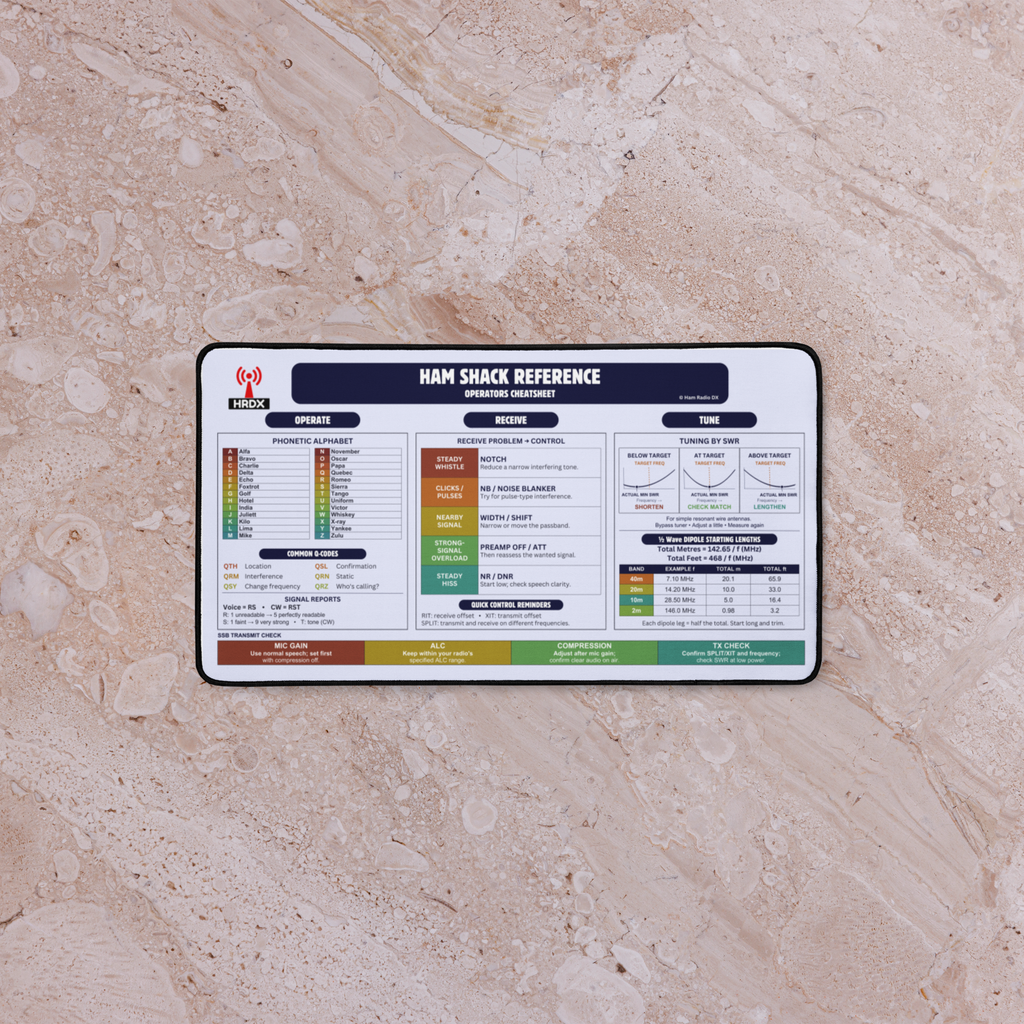
Rather than having to look them up every time you’re on the air, I’ve designed a handy Ham Radio Shack Reference Desk Mat featuring common Q-codes, the phonetic alphabet, signal reports and other useful operating references.
What Do 73, 44, 88 and Other Numbers Mean in Ham Radio?
Amateur radio has several numerical expressions that have become traditions within the hobby. Many originated during the early days of telegraph communications.
73 – Best Regards
73 is arguably the most widely used expression in amateur radio. It means “best regards” and is typically used when finishing a radio contact.
For example, “Thanks for the contact, 73!”
It is pronounced seventy-three.
44 – Greetings from Nature
44 is a traditional sign-off associated with World Wide Flora and Fauna (WWFF) and is also sometimes heard during Parks on the Air (POTA) contacts.
The two fours symbolise:
- The four elements: earth, water, air and fire.
- The four compass directions: north, south, east and west.
You might hear an operator say, “Thanks for the contact, 73 and 44!”
72 – QRP Best Wishes
72 is an informal variation of 73 commonly used by QRP enthusiasts who enjoy operating amateur radio at low power.
88 – Love and Kisses
88 is a traditional expression meaning “love and kisses”, typically exchanged between partners, family members or people who share a close relationship.
55 – Good Luck
55 is used by some amateur radio operators, particularly in Europe, to wish another operator good luck or success.
33 – Greetings Between YLs
33 is a traditional greeting or sign-off sometimes exchanged between female amateur radio operators.
Amateur Radio Modes Explained
A mode describes the method used to transmit information over radio waves. Amateur radio operators can communicate using voice, Morse code, digital text, images and other forms of data.
Voice and Traditional Modes
SSB (Single Sideband) – A bandwidth- and power-efficient form of voice communication widely used on the HF amateur radio bands.
USB (Upper Sideband) – A form of single sideband commonly used for HF voice communications on 20 metres and higher-frequency bands.
LSB (Lower Sideband) – A form of single sideband commonly used for voice communications on the 160, 80 and 40 metre amateur radio bands.
FM (Frequency Modulation) – A voice mode commonly used for local communications on the VHF and UHF amateur radio bands, including through repeaters.
AM (Amplitude Modulation) – A traditional voice mode where the amplitude of the transmitted radio signal varies with the audio being transmitted.
CW (Continuous Wave) – A mode commonly associated with Morse code, where a radio carrier is switched on and off to represent dots and dashes.
Digital Modes
FT4 – A faster digital mode similar to FT8, using 7.5-second periods. It is useful when quicker contacts are desirable.
JS8Call – A digital communications application based on the weak-signal JS8 mode, allowing operators to exchange free-text messages and have keyboard-based conversations.
RTTY (Radioteletype) – A traditional digital text communications mode still commonly used in amateur radio contests.
PSK31 (Phase Shift Keying 31) – A narrow-bandwidth digital mode used for keyboard-to-keyboard conversations.
SSTV (Slow Scan Television) – A mode used to transmit still images over radio frequencies.
ATV (Amateur Television) – The transmission of moving television images using amateur radio frequencies.
APRS (Automatic Packet Reporting System) – A digital system commonly used to share station locations, weather information, short messages and other data.
Packet Radio – A digital communications method that sends data in small groups known as packets.
Winlink – A radio messaging system that enables users to send and receive email and other information over radio links, including in situations where conventional internet access is unavailable.
Digital Voice Modes
DMR (Digital Mobile Radio) – A digital voice communications standard used in amateur radio for local and networked communications.
D-STAR (Digital Smart Technologies for Amateur Radio) – A digital voice and data communications system designed for amateur radio.
C4FM (Continuous Four-Level Frequency Modulation) – A digital modulation method used by Yaesu’s System Fusion digital voice system.
System Fusion – Yaesu’s amateur radio digital communications system, supporting C4FM digital voice and compatibility with conventional FM on suitable equipment.
M17 – An open-source digital radio protocol designed for amateur radio voice and data communications.
Amateur Radio Frequency Bands and Propagation Terms
Understanding radio propagation helps you determine when and where you might be able to make radio contacts.
RF (Radio Frequency) – Electromagnetic signals used for wireless communications.
Hz (Hertz) – A unit of frequency representing one cycle per second.
kHz (Kilohertz) – One thousand hertz.
MHz (Megahertz) – One million hertz.
GHz (Gigahertz) – One billion hertz.
Wavelength – The physical distance covered by one complete cycle of a radio wave. Many amateur radio bands are named after their approximate wavelength.
MF (Medium Frequency) – Radio frequencies between 300 kHz and 3 MHz. The 160 metre amateur radio band falls within this range.
HF (High Frequency) – Radio frequencies between 3 and 30 MHz. HF is widely used for long-distance and international amateur radio communications.
VHF (Very High Frequency) – Radio frequencies between 30 and 300 MHz. Popular amateur radio bands include 6 metres and 2 metres.
UHF (Ultra High Frequency) – Radio frequencies between 300 MHz and 3 GHz. The 70 centimetre amateur radio band is within this range.
SHF (Super High Frequency) – Radio frequencies between 3 and 30 GHz, commonly associated with microwave communications.
Propagation – The way radio signals travel from one location to another.
Band Opening – A period when propagation conditions allow radio signals to travel further than usual or reach particular locations.
Ionosphere – A region of Earth’s upper atmosphere containing ionised particles that can return certain radio signals towards Earth, enabling long-distance communications.
Skywave – Radio signals that return towards Earth through interaction with the ionosphere.
Groundwave – Radio signals that travel along the Earth’s surface.
Skip – An informal term for long-distance radio propagation, usually involving the ionosphere.
Skip Zone – An area between the reach of the groundwave and the point where a skywave signal returns to Earth, where reception may be difficult.
Line of Sight (LOS) – Radio communications where signals travel primarily along a direct path between stations. Commonly associated with VHF and UHF.
Sporadic E (Es) – A propagation phenomenon involving regions of intense ionisation in the ionosphere’s E layer, which can enable unexpected long-distance contacts, particularly on 6 metres.
Tropospheric Ducting (Tropo) – An atmospheric phenomenon that can allow VHF and UHF radio signals to travel well beyond their normal range.
Greyline (Grayline) – The region between daylight and darkness, where changing ionospheric conditions can enhance radio propagation on certain HF bands.
NVIS (Near Vertical Incidence Skywave) – A propagation technique that uses high-angle HF signals to provide regional communications over distances of several hundred kilometres.
MUF (Maximum Usable Frequency) – The highest frequency expected to support ionospheric radio communication between two locations at a given time.
SFI (Solar Flux Index) – A measurement of solar radio emissions used as an indicator of solar activity and potential HF propagation conditions.
K-Index – A measurement of short-term geomagnetic activity. Higher values can indicate disturbed propagation conditions.
A-Index – A measurement representing geomagnetic activity over a longer period, typically a day.
Solar Cycle – The approximately 11-year cycle of changing solar activity that influences HF radio propagation.
Long Path (LP) – Contacting a distant station by the longer route around the Earth.
Short Path (SP) – Contacting a distant station by the shorter route around the Earth.
Not sure which HF band to use or when?

Understanding HF propagation is one of the biggest challenges for new amateur radio operators. I’ve created a handy HF Radio Propagation Cheatsheet to take some of the guesswork out of choosing the right band, with easy-to-understand visual references you can keep in your shack.
Ham Radio Signal Reports
Amateur radio operators exchange signal reports to describe how well they are receiving another station.
One of the most common expressions you’ll hear on the HF bands is “You’re five and nine.”
The RST Signal Reporting System
RST stands for Readability, Strength and Tone.
| Component | Scale | Meaning |
|---|---|---|
| R – Readability | 1–5 | How easily your transmission can be understood. |
| S – Strength | 1–9 | How strong your received signal is. |
| T – Tone | 1–9 | The quality of your Morse code signal. |
Voice communications normally use the first two numbers, while Morse code contacts use all three.
Common Signal Reports
| Signal Report | Meaning |
|---|---|
| 59 (Five and Nine) | Perfectly readable, very strong signal. |
| 57 (Five and Seven) | Perfectly readable, moderately strong signal. |
| 55 (Five and Five) | Perfectly readable, fairly good signal strength. |
| 33 (Three and Three) | Readable with difficulty, weak signal. |
| 599 (Five Nine Nine) | A top readability, strength and tone report for CW. |
| 5NN | A shortened Morse code representation of 599. |
| 59+20 | A perfectly readable signal measuring 20 dB above S9. |
Other Signal and Audio Terms
S-Meter – A radio’s signal strength indicator, usually displaying received signals in S-units.
S9 – A strong received signal indicated on a radio’s S-meter.
SNR (Signal-to-Noise Ratio) – A measure of the strength of a signal relative to background noise, usually expressed in decibels.
dB (Decibel) – A logarithmic unit used to express ratios, such as differences in signal strength or power.
Noise Floor – The level of background noise present on a frequency or band.
RFI (Radio Frequency Interference) – Unwanted radio frequency energy that interferes with receiving or transmitting signals.
Full Quieting – An expression used in FM communications when a received signal is strong enough to eliminate audible background noise.
Loud and Clear – An informal report indicating that a transmission is strong and easily understood.
Scratchy – Describes a noisy or weak FM signal.
Picket Fencing – Rapid fluctuations in a received signal, often experienced while operating from a moving vehicle.
Splatter – Unwanted transmitted energy extending into nearby frequencies, potentially causing interference to other operators.
Waterfall – A visual display showing received radio signals across a range of frequencies over time.
Repeaters and Local Amateur Radio Communications
Many amateur radio operators make their first contacts using handheld radios and local repeaters on the VHF and UHF bands.
Simplex – Communication where stations transmit and receive on the same frequency, typically without using a repeater.
Duplex – Communication using separate transmit and receive frequencies.
Full Duplex – The ability to transmit and receive simultaneously.
Offset – The frequency difference between a repeater’s input and output frequencies.
Repeater Input – The frequency on which a repeater receives signals from users.
Repeater Output – The frequency on which a repeater transmits signals to users.
CTCSS (Continuous Tone-Coded Squelch System) – A low-frequency audio tone commonly used to access repeaters or control receiver squelch.
PL Tone (Private Line Tone) – Another commonly used name for CTCSS.
DCS (Digital-Coded Squelch) – A digital code used to control receiver squelch or access certain repeaters.
Carrier – A radio frequency signal that may be transmitted with or without modulation.
Kerchunking – Briefly transmitting into a repeater without speaking, often to check whether it can be accessed. Repeated unidentified kerchunking is generally considered poor operating practice.
Courtesy Tone – A short audible tone from a repeater indicating that the previous operator has finished transmitting.
Repeater Tail – The brief period during which a repeater continues transmitting after the incoming signal has stopped.
Time-Out Timer (TOT) – A function that stops a radio or repeater from transmitting continuously for longer than a predetermined period.
PTT (Push to Talk) – The button or function used to begin transmitting.
VOX (Voice-Operated Switch) – A function that automatically activates transmission when the operator speaks.
Squelch – A function that mutes receiver audio when no suitable signal is present.
Talkgroup (TG) – A virtual communications channel used on digital radio networks such as DMR.
Hotspot – A low-power radio gateway that connects a compatible amateur radio to a digital communications network, usually via the internet.
EchoLink – A system allowing licensed amateur radio operators to communicate with other operators and connected radio stations using internet links.
IRLP (Internet Radio Linking Project) – A system that links amateur radio stations and repeaters using the internet.
DXing, Contesting and Awards Terminology
Many amateur radio operators enjoy contacting distant or rare stations, collecting awards and participating in radio competitions.
DXing – The activity of seeking and contacting distant amateur radio stations.
DXCC (DX Century Club) – An amateur radio awards program associated with contacting at least 100 recognised DXCC entities.
DX Entity – A geographically or politically defined area recognised under the DXCC program. A DXCC entity is not necessarily an independent country.
DXpedition – An expedition to a remote, rare or otherwise desirable location for the purpose of making amateur radio contacts.
ATNO (All-Time New One) – A station, DX entity, park or other award reference that an operator has never previously worked.
DX Cluster – An online system where operators report the frequencies and callsigns of active stations.
Spot – A report indicating that a particular radio station is currently active on a specific frequency.
Self-Spotting – Posting information about your own station’s current operating frequency.
Split Operation – Operating on different transmit and receive frequencies, often used by popular DX stations to manage pileups.
Listening Up – An instruction indicating that a station is listening for callers on a higher frequency than the one it is transmitting on.
Listening Down – An instruction indicating that a station is listening for callers on a lower frequency than the one it is transmitting on.
Contest – A competitive amateur radio event where operators attempt to make contacts according to a defined set of rules.
Radiosport – Another term for competitive amateur radio activities, particularly contesting.
Multiplier – A contest scoring element, often awarded for contacting different countries, states, zones or other defined locations.
Run / Running – Remaining on one frequency and calling CQ to make successive contacts.
S&P (Search and Pounce) – A contesting technique involving tuning across a band to find and contact stations.
Dupe – A duplicate radio contact, particularly in a contest.
Serial Number – A sequential contact number exchanged during certain amateur radio contests.
Field Day – An organised amateur radio event often involving temporary outdoor stations, practical operating skills and making radio contacts.
WAS (Worked All States) – An award for making confirmed amateur radio contacts with all 50 US states.
WAC (Worked All Continents) – An award for making confirmed contacts with stations on six continents.
IOTA (Islands on the Air) – An amateur radio program encouraging contacts with stations located on designated islands and island groups.
Parks on the Air (POTA), Summits on the Air (SOTA) and Portable Operating
Portable amateur radio is a great way to combine the hobby with travel, camping, hiking and outdoor activities.
POTA (Parks on the Air) – An international amateur radio program encouraging operators to make radio contacts from designated parks and protected areas.
SOTA (Summits on the Air) – An amateur radio awards program encouraging operators to make contacts from qualifying mountain summits.
WWFF (World Wide Flora and Fauna) – An international amateur radio program promoting operations from designated nature and conservation areas.
Activator – An amateur radio operator making contacts from a recognised park, summit or other eligible location.
Activation – An operating session from a designated location that meets the relevant program’s activation requirements.
Hunter – An operator who makes contact with an activator, particularly in Parks on the Air.
Chaser – An operator who contacts an activator, particularly in Summits on the Air.
P2P (Park to Park) – A contact between two stations operating from eligible POTA parks.
S2S (Summit to Summit) – A contact between two stations operating from qualifying SOTA summits.
Park Reference – A unique identifier assigned to a park participating in an amateur radio program.
Summit Reference – A unique identifier assigned to a qualifying SOTA summit.
Two-fer – Operating from a location that qualifies for two park references simultaneously under the applicable program rules.
Rove – An activity involving operating from multiple eligible locations in succession.
Portable (/P) – Operating a radio station from a temporary location away from your usual station.
Mobile (/M) – Operating an amateur radio station from a vehicle.
Maritime Mobile (/MM) – Operating an amateur radio station at sea.
Aeronautical Mobile (/AM) – Operating an amateur radio station aboard an aircraft, where permitted.
QRP – Low-power amateur radio operation, commonly associated with portable stations. A widely used convention is 5 watts or less for CW and 10 watts PEP or less for SSB, although definitions can vary.
Amateur Radio Satellites and Space Communications
Amateur radio isn’t limited to communications here on Earth. Operators can also communicate through satellites, contact astronauts and even bounce signals off the Moon.
AMSAT – A name associated with organisations that promote and develop amateur radio satellites.
ARISS (Amateur Radio on the International Space Station) – A program facilitating amateur radio communications involving the International Space Station.
ISS (International Space Station) – An orbiting space station carrying amateur radio equipment.
LEO (Low Earth Orbit) – A category of relatively low-altitude Earth orbits used by many amateur radio satellites.
Uplink – The frequency used to transmit signals towards a satellite.
Downlink – The frequency used to receive signals from a satellite.
Satellite Pass – A period when a satellite is within range of a ground-based station.
AOS (Acquisition of Signal) – The point when a satellite’s signal first becomes available during a pass.
LOS (Loss of Signal) – The point when a satellite’s signal is lost at the end of a pass.
Doppler Shift – An apparent change in received frequency caused by relative movement between a transmitting and receiving station.
Meteor Scatter (MS) – A communications technique using ionised trails created by meteors to reflect radio signals over long distances.
Amateur Radio Logging, Software and Contact Confirmations
QSL Card – A physical or electronic card confirming that a radio contact took place or that a station was heard.
QSL Manager – A person who handles contact confirmations on behalf of another amateur radio station.
LoTW (Logbook of the World) – An electronic contact confirmation system operated by the ARRL.
eQSL – An online service for exchanging electronic QSL cards.
ADIF (Amateur Data Interchange Format) – A standard file format used to exchange amateur radio logbook information between software applications and websites.
UTC (Coordinated Universal Time) – The international time standard commonly used in amateur radio logging, regardless of the operator’s local time zone.
Zulu Time – Another way of referring to UTC.
Grid Square – A geographical location identifier used by amateur radio operators, particularly in VHF, satellite and digital communications.
Maidenhead Locator – The location system used to define amateur radio grid squares, using combinations of letters and numbers.
QRZ.com – A popular amateur radio website featuring a callsign directory, electronic logbook and other resources.
PSK Reporter – An online service displaying reception reports from amateur radio stations around the world.
RBN (Reverse Beacon Network) – A network of automated receiving stations that detect and report amateur radio signals.
WebSDR – An internet-accessible software-defined radio receiver that allows multiple users to listen to radio signals remotely.
CAT Control (Computer-Aided Transceiver Control) – A method of controlling a radio’s functions from a computer.
WSJT-X – Popular amateur radio software supporting weak-signal digital modes such as FT8, FT4 and WSPR.
Common Morse Code Abbreviations
Morse code operators frequently use shortened words and expressions to make radio communications more efficient.
| Abbreviation | Meaning |
|---|---|
| BK | Break |
| BT | Separation between parts of a message |
| CL | Closing station |
| CUL | See you later |
| DE | From |
| ES | And |
| FB | Fine business / very good |
| GA | Good afternoon |
| GB | Goodbye |
| GE | Good evening |
| GM | Good morning |
| GN | Good night |
| HI | Laughter |
| HR | Here |
| HW | How |
| K | Go ahead / invitation to transmit |
| KN | Invitation for a specific station to transmit |
| NR | Number |
| PSE | Please |
| PWR | Power |
| R | Received / Roger |
| RIG | Radio equipment |
| SK | End of contact |
| SRI | Sorry |
| TNX | Thanks |
| TU | Thank you |
| UR | Your / You’re |
| VY | Very |
| WPM | Words per minute |
| WX | Weather |
| YR | Your / Year, depending on context |
Some Morse code procedural signals, known as prosigns, are transmitted as a single continuous character without the normal spacing between letters.
The Amateur Radio Phonetic Alphabet
Amateur radio operators often use the international phonetic alphabet to communicate callsigns and other information clearly, particularly when signals are weak or interference is present.
| Letter | Phonetic | Letter | Phonetic |
|---|---|---|---|
| A | Alfa (Alpha) | N | November |
| B | Bravo | O | Oscar |
| C | Charlie | P | Papa |
| D | Delta | Q | Quebec |
| E | Echo | R | Romeo |
| F | Foxtrot | S | Sierra |
| G | Golf | T | Tango |
| H | Hotel | U | Uniform |
| I | India | V | Victor |
| J | Juliett | W | Whiskey |
| K | Kilo | X | X-ray |
| L | Lima | Y | Yankee |
| M | Mike | Z | Zulu |
For example, my amateur radio callsign, VK7HH, would be spoken phonetically as:
Victor Kilo Seven Hotel Hotel
Common Ham Radio Organisations and Abbreviations
ARRL (American Radio Relay League) – The national amateur radio association in the United States.
WIA (Wireless Institute of Australia) – A national amateur radio organisation in Australia.
RSGB (Radio Society of Great Britain) – The national amateur radio society in the United Kingdom.
RAC (Radio Amateurs of Canada) – The national amateur radio organisation in Canada.
NZART (New Zealand Association of Radio Transmitters) – The national amateur radio organisation in New Zealand.
IARU (International Amateur Radio Union) – An international organisation representing the interests of amateur radio worldwide.
ITU (International Telecommunication Union) – A United Nations agency responsible for international coordination of telecommunications, including radio spectrum.
FCC (Federal Communications Commission) – The telecommunications regulator in the United States.
ACMA (Australian Communications and Media Authority) – The communications and media regulator in Australia.
Ofcom (Office of Communications) – The communications regulator in the United Kingdom.
ARES (Amateur Radio Emergency Service) – A US-based amateur radio emergency communications program.
RACES (Radio Amateur Civil Emergency Service) – A US amateur radio emergency communications service operating under defined governmental arrangements.
WICEN (Wireless Institute Civil Emergency Network) – An Australian amateur radio emergency communications network.
Frequently Asked Questions About Ham Radio Terminology
What does CQ mean in ham radio?
CQ is a general call indicating that an amateur radio operator is looking to make contact with any station listening on the frequency.
Why do ham radio operators say 73?
73 means best regards. It is a traditional way of ending an amateur radio contact and wishing the other operator well.
What does 44 mean in ham radio?
44 is a traditional expression associated with World Wide Flora and Fauna (WWFF) and is sometimes used by Parks on the Air operators. It represents the four elements of nature and the four compass directions.
What does QSO mean in ham radio?
A QSO is a two-way radio contact or conversation between amateur radio stations.
What does QSL mean in ham radio?
QSL means acknowledging receipt of a transmission or message. It can also refer to confirming a completed radio contact using a physical or electronic QSL card.
What does QTH mean in ham radio?
QTH refers to the geographical location of an amateur radio station or operator.
What does QRM mean in ham radio?
QRM refers to interference from other radio signals or man-made electrical sources. In comparison, QRN generally refers to atmospheric static or naturally occurring noise.
What does QRZ mean in ham radio?
QRZ means “Who is calling me?” It is commonly used when an operator knows someone has called but has not been able to identify their callsign.
What does QRP mean in ham radio?
QRP is commonly used to describe low-power amateur radio operation. Many QRP enthusiasts enjoy the challenge of making long-distance contacts using only a few watts of transmit power.
What does DX mean in ham radio?
DX refers to long-distance radio communications. On HF, this often means contacting stations in other countries or continents.
What does 5 and 9 mean in ham radio?
A five and nine (59) signal report indicates that your transmission is perfectly readable, with very strong received signal strength.
What is the difference between SSB and FM in ham radio?
SSB is an efficient voice communications mode commonly used for long-distance HF communications. FM is typically used for local VHF and UHF communications, including through amateur radio repeaters.
What is FT8 in ham radio?
FT8 is a weak-signal digital communications mode that allows operators to exchange short, computer-generated messages. It is particularly useful when signals are too weak for reliable voice communications.
What is the difference between POTA and SOTA?
Parks on the Air (POTA) encourages amateur radio operations from designated parks, while Summits on the Air (SOTA) focuses on qualifying mountain summits.
Do I need to learn Q-codes before using ham radio?
No. You can communicate using plain language. Most amateur radio operators gradually learn Q-codes and common abbreviations simply by listening to and participating in conversations.
Ready to Get on the Air?
You don’t need to memorise every term in this amateur radio glossary to become a good radio operator.
In fact, one of the best ways to learn the language of ham radio is to start making contacts, listening to experienced operators and experimenting with different aspects of the hobby.
But if you’re struggling to work out where to start, you’re certainly not alone.
I created Ham Radio in 30 Days: Zero to Hero to help new and returning amateur radio operators bridge the gap between getting their licence and actually enjoying the hobby.
You’ll learn practical operating techniques, how to make radio contacts, how to understand propagation and how to become more confident using your radio.
Discover Ham Radio in 30 Days: Zero to Hero
73,
Hayden – VK7HH / KD9SSB
Ham Radio DX